Why Can't I Make My Song Louder?
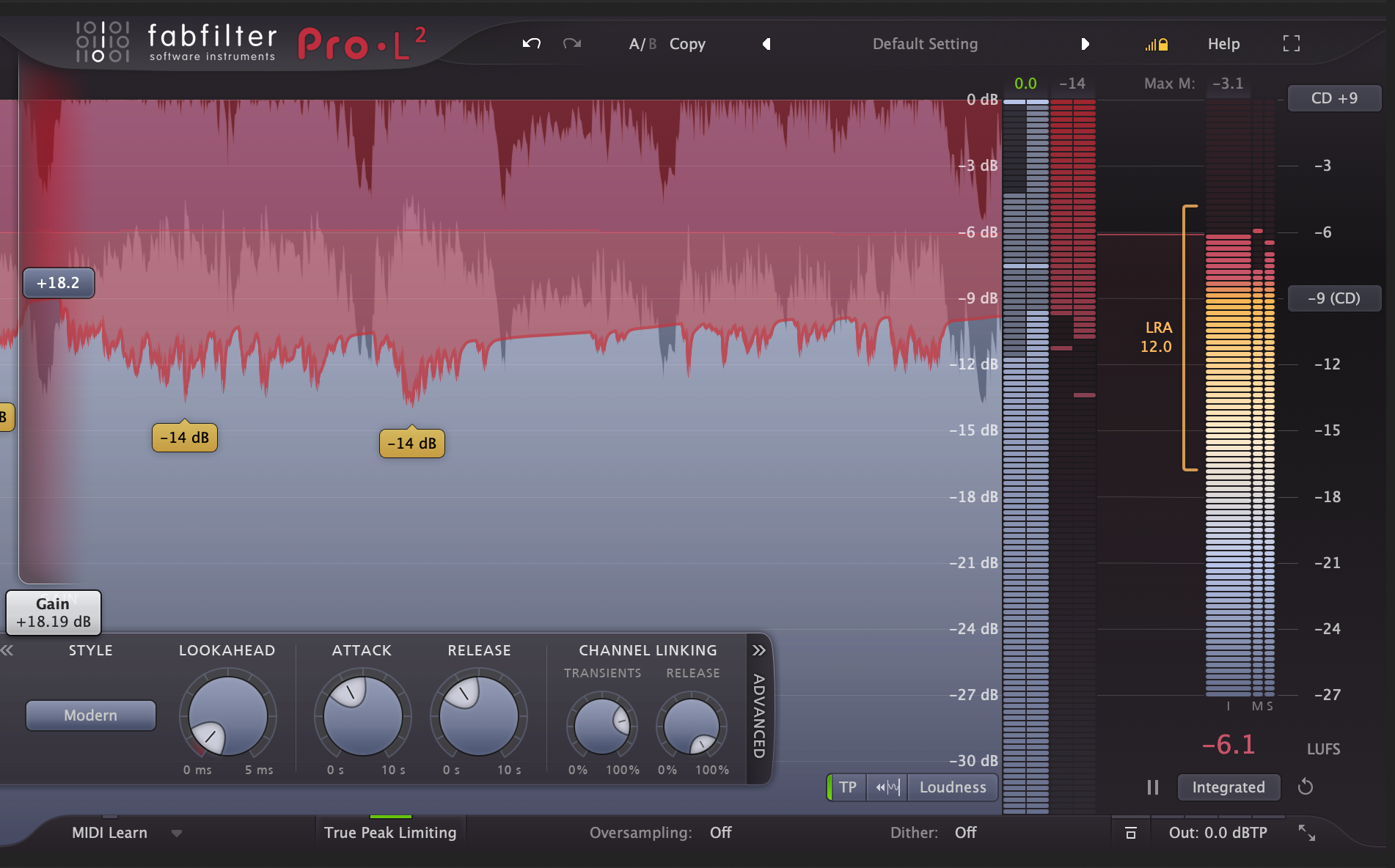
Does your limiter look like this when trying to make your song louder? You might want to reconsider your approach.
One of the most common questions I hear is:
"Why is my track so quiet?"
"Can you make my song louder?"
"Why doesn't my mix sound as loud as commercial releases?"
Even when slamming your final limiter, your track may just not sound as loud as you’d like. Most people assume the answer lives in mastering. Sometimes it does. But more often, loudness starts much earlier in the process. In fact, mastering is usually the last step in a chain that begins with arrangement, recording, and mixing. The farther upstream the problem is, the harder it becomes to fix later.
One of the things I learned last, but ultimately made the most sense:
Loudness starts with arrangement
This is the part that gets talked about the least. Every instrument, vocal, synth, effect, etc occupies space. When too many things compete for the same space, they begin to mask each other. The result is a mix that feels crowded - which is difficult to make louder.
One of my favorite examples is "Violence" by Low.
The arrangement is incredibly sparse. Voice, guitar, bass, snare + cymbal played with a brush. Each element has room to exist.
Because nothing is fighting for attention, the song at times feels remarkably loud and present without sounding aggressive, overly compressed, or slammed into a limiter.
Loudness is often a function of what you leave out.
Side note: I saw Low perform at Orchestra Hall in Minneapolis in the early 2000’s - it was one of the clearest and loudest shows I have seen, and it was achieved through acoustic amplification - i.e. they used the rooms' natural acoustics. It was truly amazing.
Recording matters more than most people think
A good recording is easier to mix, easier to master, and easier to make loud. But what does a “good” recording even mean? I often compare it to photography.
If a photograph is out of focus, you might be able to sharpen or otherwise enhance it later - but you can't truly recover what wasn't captured in the first place.
The same is true of audio.
Mic placement, source tone, performance, room acoustics, and recording technique all influence how much work will be required later. If this were not the case, studios wouldn’t spend the time and resources required to create an amazing live room. A great mix rarely begins with a poor capture.
Of course, “capture” doesn’t always mean microphones in a live room. A lot of music today is built with synths, samples, drum machines, virtual instruments, etc. But the principle is the same: the earlier sound choices matter. Whether you’re placing a mic in front of an amp or choosing a kick sample, the quality and intention of the source shape everything that comes after.
Mixing creates the space for loudness
Many loudness problems are actually balance problems, and one of the biggest culprits is low end. Bass consumes a tremendous amount of headroom, and it's surprisingly easy to underestimate how much bass exists in a mix - especially if your monitoring isn't telling the whole story.
Another common issue is the classic "smiley face" mix: lots of lows, lots of highs, and not enough midrange. As someone that used to do this, I totally get it! It sounds exciting at first. But then when you try to make it louder, it often crashes out pretty quickly.
Contrary to what some audio/influencer YouTube titles might suggest, there are no “secret tricks” (that top mixers don’t want you to know about!). But there is the midrange - and when it comes to perceived loudness, that might be the closest thing to “magic”.
The midrange is where much of the perceived loudness exists. To exemplify this idea, one “trick” you can do (that I am pretty sure is NOT used by the pros): make a +3db high shelf and start it at around 1Khz. You hear that? Instantly louder, even if you compensate for the added gain. Is it better though? Maybe. Probably not. It likely also introduces some harshness and/or sibilance, but it’s definitely louder.
A quick example is “Follow the Winner” by Royal Trux. Unlike the Low track, it isn’t sparse or pristine. The arrangement is full, the recording feels raw, and the mix is not trying to be traditionally “beautiful.” But it works because the mids are pushed forward. The track feels loud because its energy is focused where our ears are most sensitive: the midrange. That focus suits Royal Trux beautifully — it makes them feel loud, immediate, and alive. Put a smiley-face EQ on it, and I’m not sure the spell survives! But I digress.
The last point I want to make about mixing and loudness:
Instead of asking: "What should I boost?" Try asking: "What can I remove?"
I get it, boosting is way more fun than cutting. Boost til your problems go away, right? But when it comes to loudness, the same principle applies as arrangement: creating space is often a better path to loudness than simply adding more energy.
Removing what isn’t needed often lets the important things become louder.
What about mastering?
Mastering absolutely affects loudness.
Traditionally, it’s the stage where the final level is set and small tonal or dynamic adjustments help a mix translate across different listening environments.
But mastering can only do so much.
By this point, the biggest loudness decisions have already been made through the arrangement, recording, and mix. A mastering engineer can often improve loudness, but they usually can’t create space that isn’t already there, at least not in the same way the earlier stages can.
This is part of why loudness used to feel like it “came from mastering.” The mastering engineer was often the person setting the final level.
Today, that line is blurrier. Many mixes already arrive with bus compression, limiting, and significant level added from the start. There’s nothing inherently wrong with that, but it can leave less room for the mastering engineer to work.
That’s one reason stem mastering has become more common.
Instead of working from one stereo file, the mastering engineer receives groups of tracks - for example drums, bass, vocals, synths, and guitars. This gives them more flexibility to adjust the balance, solve problems, and create the conditions for perceived loudness.
Sometimes the solution is mastering, but often it's somewhere earlier in the chain. I know that’s not always what people want to hear. But as an engineer, I’d rather give you the most honest and useful guidance than pretend there’s a magic plugin that can fix your loudness problem (you know, the one that the top pros don’t want you to know about!).
Ok, now what?
Practical Advice
If your song isn't getting as loud as you'd like:
Simplify the arrangement where possible.
Pay attention to frequency distribution, and especially to low-end balance.
Reference commercial releases at matched volume (and choose something with similar arrangement).
Focus on creating space rather than adding more.
Keep developing your mixing skills.
Consider working with a professional. An often hidden value in doing so is that they can give you advice and pointers, and it’s usually coming from years of experience. And experience is truly the key to most things - not shortcuts, hacks, or magic plug-ins.
Final Thought
The loudest-sounding records aren't always the ones with the highest LUFS values. They're often the ones where every element has room to be heard. Loudness isn't something that's added at the end, it's something that's built from the very beginning.
If you’re struggling to get your track loud enough, there’s no shame in that. It’s one of the most common issues artists run into. Sometimes the answer is mastering. Sometimes it’s a mix adjustment. Sometimes it’s simply getting another set of ears on the song.
Lastly, remember: there are no rules or standards when it comes to art.
Some of the greatest records ever made broke the “rules.” They were distorted, noisy, unbalanced, unconventional, or technically imperfect — and that’s exactly why they worked.
But! Sound itself is physics, and physics has rules. Frequencies interact. Instruments mask each other. Low end takes up space and eats headroom. Dynamics affect loudness. Understanding those things will give you more control over where you can take your sounds.
It’s also okay to not be loud. mbv by My Bloody Valentine is a great example. For such a dense, guitar-heavy record, it isn’t crushed to death. It has room to breathe, and in a loudness-obsessed era, that restraint helps it stand apart.
Loudness can be powerful. But it isn’t the only way to make something feel big.
If you’re stuck, I’m happy to help you figure out where the issue is — and what the best next step might be.
